

EIP Overview
EIP
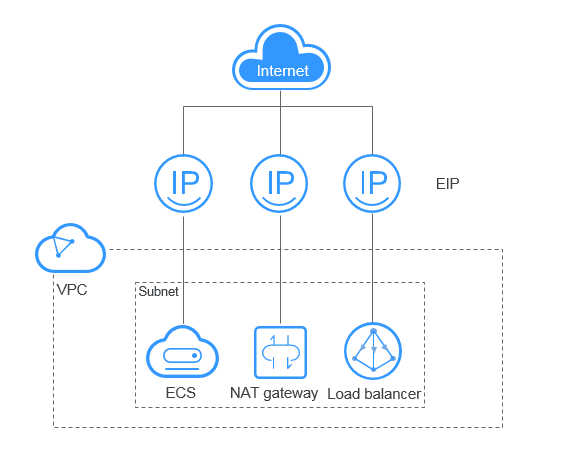
The Elastic IP (EIP) service enables your cloud resources to communicate with the Internet using static public IP addresses and scalable bandwidths. If a resource has an EIP bound, it can directly access the Internet. If a resource only has a private IP address, it cannot directly access the Internet.
EIPs can be bound to or unbound from ECSs, BMSs, virtual IP addresses, NAT gateways, or load balancers.
Each EIP can be bound to only one cloud resource at a time.
You can use public NAT gateways to enable ECSs in the VPC to share an EIP to access the Internet or provide services accessible from the Internet. For details, see Allowing a Private Network to Access the Internet Using SNAT.
EIP Quotas
You can log in to the console to query your EIP quotas.
- Your request for a larger quota will only be approved if your account has valid orders and you are continuously using cloud resources. If you have released resources immediately after subscribing to them multiple times, your request for quota increase will be declined.
- If you have increased the EIP quota but you have not used the quota for a long time, Huawei Cloud will reduce the quota to the default value.
Constraints
- If a yearly/monthly EIP is not renewed after it expires, or if the arrears of a pay-per-use EIP are not paid in a timely manner, the EIP may be released and cannot be recovered.
- If the used EIP bandwidth exceeds the specified size or is attacked (usually by a DDoS attack), the EIP will be blocked but can still be bound or unbound.
- Constraints on binding or unbinding an EIP to or from an instance:
- An EIP can be bound to only one cloud resource at a time.
- An EIP that has already been bound to a cloud resource cannot be bound to another resource without first being unbound from the current resource.
- The EIP remains unchanged:
- No matter you start or stop the ECS.
- When you modify its bandwidth size.
- When you modify its billing mode or bandwidth size.
Binding an EIP to an Instance

| No. | Step | Description |
|---|---|---|
| 1 | You can assign an EIP and bind it to a cloud resource to allow the resource to access the Internet. | |
| 2 |
|
Related Operations
Binding or Unbinding an EIP: After an EIP is assigned, you can bind it to a cloud resource such as an ECS for Internet access.
Adding EIPs to or Removing EIPs from a Shared Bandwidth: After a shared bandwidth is assigned, you can add multiple pay-per-use EIPs to it so that all EIPs share the same bandwidth. Then, your network operation costs will be lowered and your system O&M as well as resource statistics will be simplified.


