

Rules for Handling Record Set Conflicts
Causes of Record Set Conflicts
Some record sets of the same name and line but different types cannot coexist. Otherwise, the resolution fails.
The possible causes are as follows:
- Constraints on CNAME record sets: A CNAME record set cannot coexist with some types of record sets. For example, if a subdomain already has a CNAME record set configured, it cannot have other types of record sets, such as A or AAAA. Otherwise, resolution may fail.
- Resolution sequence and priority: The DNS server resolves a domain name based on the record set type and priority. Improper configuration may cause resolution failure or conflict.
- Multiple resolution paths: If a domain name has multiple record sets of different types, the DNS server resolves the domain name through different paths. This results in inconsistent or conflicting resolution results.
Special Handling When the Name Is @ or Empty
If the name is @ or empty, it indicates that the record set is configured for the primary domain name. According to RFC 1034 and RFC 2181, CNAME has the highest priority. If a CNAME record set coexists with another record set type of the name and line, it overrides their resolution, which can cause service failures (for example, email-receiving or domain name verification failures).
When the name is @ or empty, Huawei Cloud DNS applies optimized conflict-handling rules for certain record set types. It also provides risk warnings to maintain standard compliance while allowing flexible service deployment.
If the name is @ or left blank, CNAME can coexist with MX or TXT of the same line. However, this may cause service risks.
CNAME and MX Coexist When the Name Is @ or Left Blank
| Record Set Type | Name | Line | Value |
|---|---|---|---|
| MX | @ or left blank | Default | 10 mailserver.example.com |
| CNAME | @ or left blank | Default | www.example.com |

This configuration may result in email-receiving anomalies, including intermittent failures.
If the local DNS server preferentially resolves and caches the CNAME record set, it will intercept MX resolution requests. As a result, the email server cannot obtain the MX record set, leading to email-receiving anomalies, including intermittent failures.
CNAME and TXT Coexist When the Name Is @ or Left Blank
| Record Set Type | Name | Line | Value |
|---|---|---|---|
| TXT | @ or left blank | Default | v=spf1 include:spf.example.com ~all |
| CNAME | @ or left blank | Default | www.example.com |
This configuration may cause TXT-based verification to fail, including SSL certificate validation, domain ownership checks, and SPF verification.
Record Set Conflict Rules
If message "This record set is in conflict with an existing one" is displayed, the record set you are trying to add conflicts with or is the same as an existing record set.
Table 1 lists the rules.
| Record Set Type | NS | CNAME | A | AAAA | MX | TXT | PTR | SRV | CAA |
| NS | No limita | Conflict | No limit | No limit | No limit | No limit | No limit | No limit | No limit |
| CNAME | Conflictb | No limit | Conflict | Conflict | No limit | No limit | Conflict | Conflict | Conflict |
| A | No limit | Conflict | No limit | No limit | No limit | No limit | No limit | No limit | No limit |
| AAAA | No limit | Conflict | No limit | No limit | No limit | No limit | No limit | No limit | No limit |
| MX | No limit | No limit | No limit | No limit | No limit | No limit | No limit | No limit | No limit |
| TXT | No limit | No limit | No limit | No limit | No limit | No limit | No limit | No limit | No limit |
| PTR | No limit | Conflict | No limit | No limit | No limit | No limit | No limit | No limit | No limit |
| SRV | No limit | Conflict | No limit | No limit | No limit | No limit | No limit | No limit | No limit |
| CAA | No limit | Conflict | No limit | No limit | No limit | No limit | No limit | No limit | No limit |
| |||||||||
Record Set Conflict Troubleshooting
Conflicts when Adding an NS Record Set
You have hosted domain name example.com on the DNS service. An NS record set and an SOA record set are automatically created for the hosted zone and cannot be deleted.
If the resolution line is the same, no NS record set can be added to the domain name example.com.
In this case, use either of the following methods to add a record set:
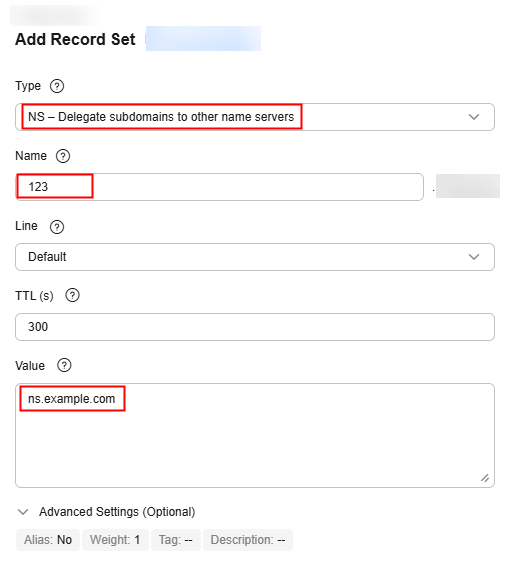
- Method 1: Add an NS record set for a subdomain of the domain name.
In the following figure, an NS record set is added for 123.example.com, and the value of the record set is ns.example.com.
Figure 1 Adding an NS record set
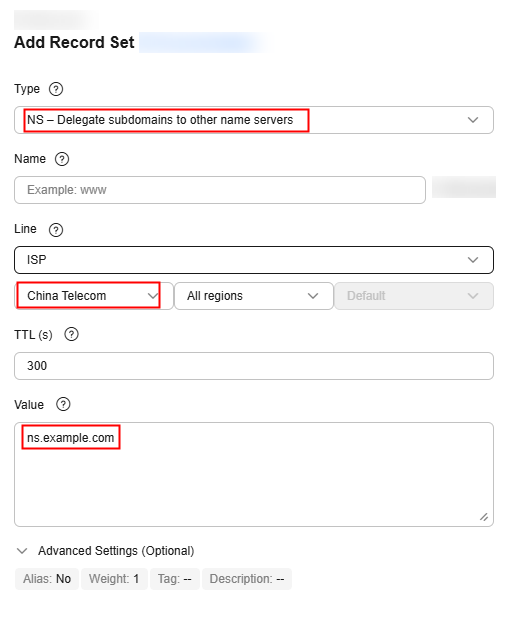
- Method 2: Add an NS record set for example.com, with a resolution line other than the default line.
In the following figure, an NS record set with the line type set to ISP is added for example.com, and the value of the record set is ns.example.com.
Figure 2 Adding an NS record set with an ISP line
- Method 3: Change the value of the NS record set added to example.com.
For details, see Modifying a Record Set.
To configure a new authoritative DNS server address for a domain name, modify the value of the NS record set added to the hosted zone. For details, see What Are Huawei Cloud DNS Servers?
Other Conflicts
If message "This record set is in conflict with an existing one" is displayed, perform either of the following operations if you still want to add a record set.
- Add a record set of a different name for a subdomain of the domain name.
- Add a record set of a different line type. Select a line other than Default.
- Delete the record set that conflicts with others and then add another one.
Deleting a record set may cause domain name resolution to fail.
What is your overall rating for this page?
Thank you very much for your feedback. We will continue working to improve the documentation.See the reply and handling status in My Cloud VOC.
For any further questions, feel free to contact us through the chatbot.
Chatbot


