

PoolBinding Overview
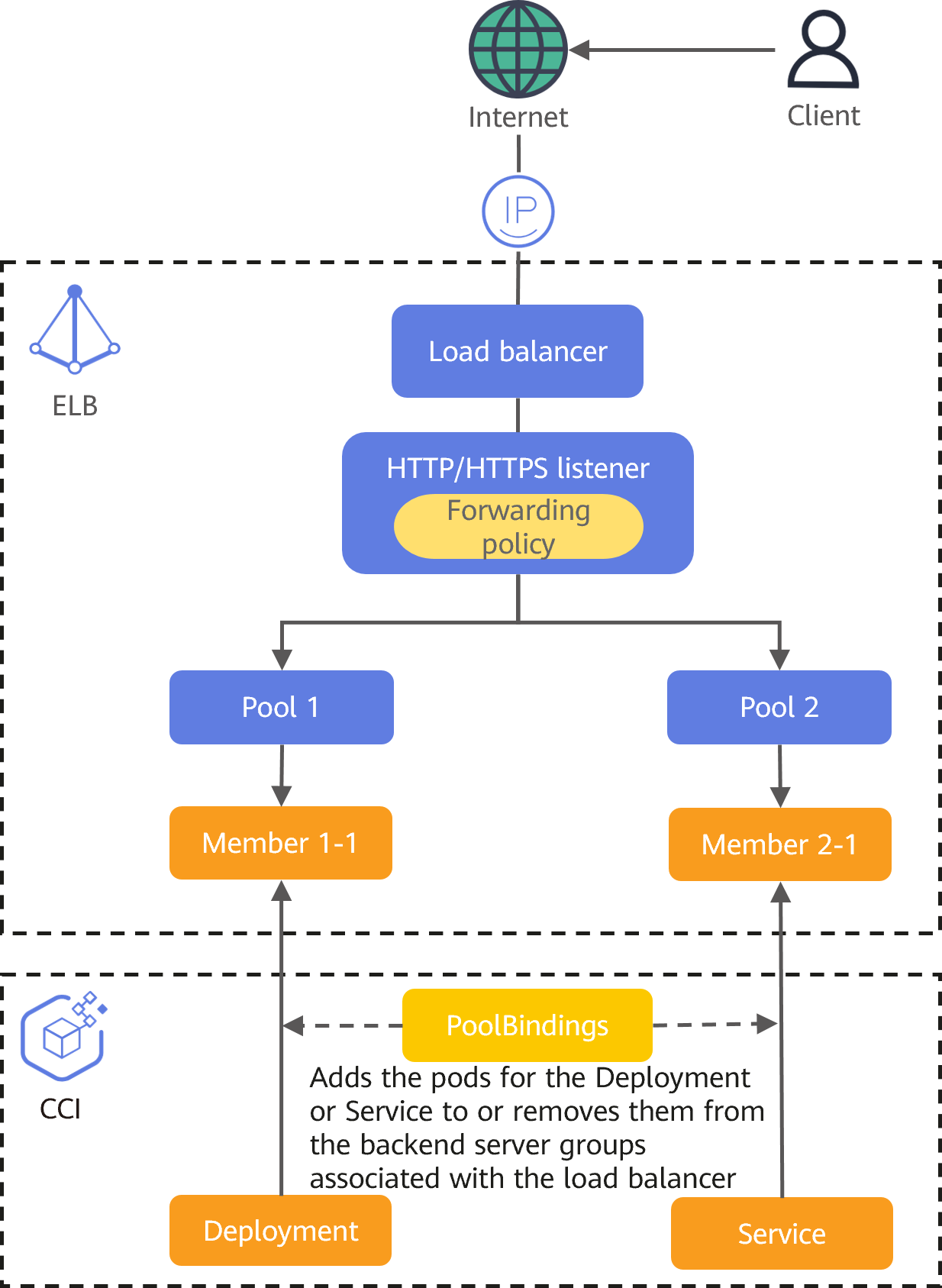
After deploying a workload on CCI 2.0, you can use ELB to enable access to the workload over the public network. CCI 2.0 provides PoolBindings to handle a large number of HTTP/HTTPS requests. A PoolBinding can automatically add the pods of a Deployment or Service to a backend server group (pool) associated with the load balancer or remove them from the backend server group (pool). You can specify the load balancer and listener configurations as needed and configure advanced forwarding policies on the ELB console for load balancing at Layer 7.
Constraints
- PoolBindings can only be associated with hybrid backend server groups whose forwarding mode is load balancing. CCI 2.0 only supports backend pods with IPv4 addresses but not backend pods with IPv6 addresses.
- A PoolBinding can only be associated with one backend server group of a dedicated load balancer. Backend server groups of shared load balancers are not supported. The VPC where the load balancer and backend server group are running must be the same as that of the namespace where the PoolBinding is created.
- PoolBindings support two types of backend objects: Deployments and Services.
- Creating PoolBindings on the CCI 2.0 console is not supported. You can create PoolBindings using the curl command or ccictl. For details about how to configure ccictl, see ccictl Configuration Guide. PoolBindings can be created, deleted, and queried, but cannot be updated.
- For details about the constraints on the load balancer configuration, see Notes and Constraints.
What is your overall rating for this page?
Thank you very much for your feedback. We will continue working to improve the documentation.See the reply and handling status in My Cloud VOC.
For any further questions, feel free to contact us through the chatbot.
Chatbot


