

IVR Traffic Report by Access Code
The IVR traffic report by access code collects statistics on the inbound call traffic of IVRs by access code in a specified period, and provides indicators including the number of inbound calls and number of successful inbound calls.
Procedure
- Sign in to the AICC as a tenant administrator or an inspector and choose to query IVR traffic report data by access code. Figure 1 IVR Traffic Report by AccessCode
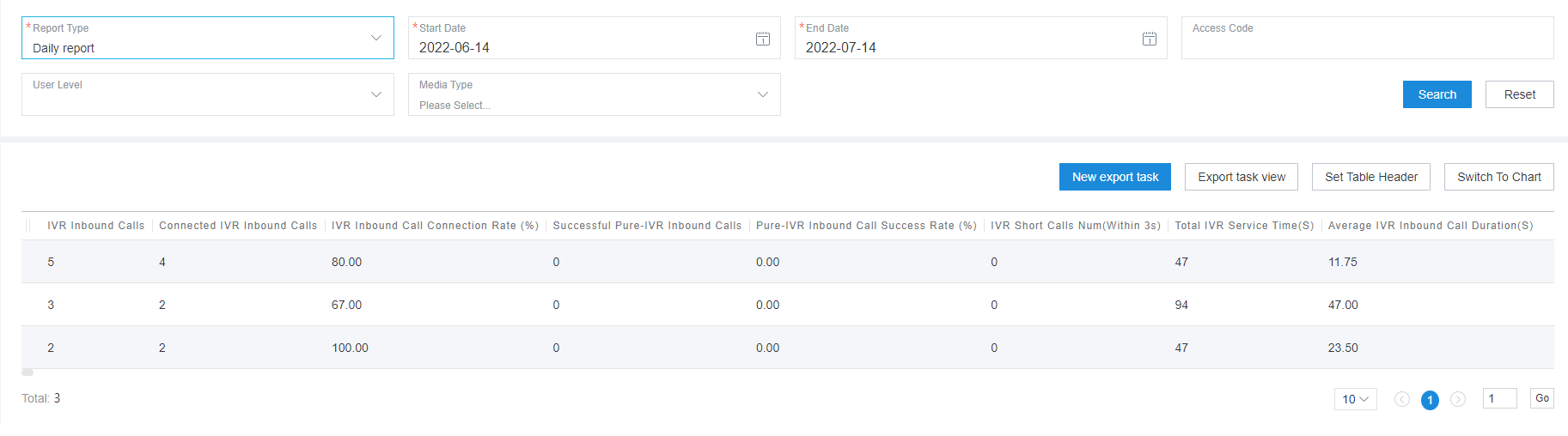
- Report Type: The options are Daily report, Weekly report, and Monthly report.
- Report time: Set the time range for report data query.
- Daily report: The time range cannot exceed 31 days.
- Weekly report: Set the start year and week as well as the end ones.
- Monthly report: Set the start year and month as well as the end ones.

The Start Week/End Week and Start Month/End Month drop-down list boxes support search and filtering.
- OU selection:
- If the tenant parameter Has the tenant enabled inter-organization data isolation enforcement is set to Yes, OUs that can be selected are subject to the configured permissions.
- Accounts without the permission under configured:
- If the Viewing and Editing Home Organization Data and View Lower-Level Organization Data permissions under System Public Permissions are not configured, only the OUs specified by Accessible Organizations configured on the Employee Info/Organization Unit page can be selected.
If accessible OUs are configured both on the Employee Info and Organization Unit pages, the permissions on the accessible OUs configured on the Employee Info page take precedence.
- If the permission under is configured, the data under the OU (excluding sub-OUs) to which the current business account belongs can be viewed.
- If the permission under is configured, the data under the sub-OUs of the OU to which the current business account belongs can be viewed.
- If the Viewing and Editing Home Organization Data and View Lower-Level Organization Data permissions under System Public Permissions are not configured, only the OUs specified by Accessible Organizations configured on the Employee Info/Organization Unit page can be selected.
- Accounts with the View All Organization Data permission under System Public Permissions configured: All OUs can be selected.
- Operations supported for OU selection:
- Include Sub-Organizations: When this option is selected, the sub-OUs of selected OUs are selected by one click.
- The number of OUs that can be selected is specified by the value of the system parameter Maximum number of OU organizational unit queries on the page.
- Accounts without the permission under configured:
- If the preceding tenant parameter is set to No, the Select OU parameter is hidden.
- If the tenant parameter Has the tenant enabled inter-organization data isolation enforcement is set to Yes, OUs that can be selected are subject to the configured permissions.
- Called Number: Fuzzy search is supported. The value is a number of at least three digits. In chart mode, the value can contain fewer than three digits.
After the tenant parameter Has the tenant enabled inter-organization data isolation enforcement is set to Yes, only access codes under the selected OUs can be selected.
- User Level: The options are existing customer levels of the VCC on the web configuration console.
- Media Type
- Voice
- Video
- Voice Click to Dial
- Video Click to Dial
- Filter indicators.
- Click Set Table Header. The Filter Indicator dialog box is displayed. Figure 2 Filter Indicator

Table 1 Indicators in the Filter Indicator dialog box Indicator
Description
IVR Inbound Calls
Total number of inbound calls made using the IVR.
Connected IVR Inbound Calls
Number of IVR inbound calls whose call duration is greater than 0.
IVR Inbound Call Connection Rate (%)
Percentage of the number of connected IVR inbound calls to the number of IVR inbound call requests.
Successful Pure-IVR Inbound Calls
Number of successful inbound calls processed only by the IVR, that is, number of successful inbound calls that are not processed by any agent.
Pure-IVR Inbound Call Success Rate (%)
Percentage of the number of calls processed only by the IVR in the total number of inbound calls. Pure-IVR inbound call success rate = Successful pure-IVR inbound calls/(Successful pure-IVR inbound calls + Number of agent answered calls) x 100
IVR Short Calls Num(Within 3s)
Number of calls whose IVR duration is greater than 0 and less than or equal to 3 seconds.
Total IVR Service Time(s)
Total IVR call duration. If a call is connected to the IVR for multiple times, the IVR service duration is the total IVR call duration.
Average IVR Inbound Call Duration(s)
Average IVR inbound call duration = IVR inbound call duration/Number of connected IVR inbound calls
- Select the report indicators to be displayed and click OK to save the configuration.
- Click Set Table Header. The Filter Indicator dialog box is displayed.
- Switch the data display mode.
- Click Switch To Chart to switch the data display mode from table to line chart and bar chart.
In chart mode, you can set search criteria and click Search to filter specific data based on the search criteria.
- Click Switch To Table to switch the data display mode from line chart and bar chart to table.
- Click Switch To Chart to switch the data display mode from table to line chart and bar chart.
- Export report data.
- Click New Export Task. The export task dialog box is displayed.
- Configure an export task.
- Export File Format: The exported file can be in CSV or PDF format.
- Compressed password: The value is a string of 8 to 12 characters and must contain letters, digits, and special characters (excluding |;&$-<>/\`!#(){}, spaces, newline characters, and tabs).
- The compression password is used to open the downloaded package.
- You do not need to configure the compression password in the independent deployment environment.
- Click OK to create an export task.
- Click Export Task View to view the export tasks in the last seven days.
- Select the created export task based on Export Start Time and Status, and click download to export the report file to the local PC. To open the report file on the local PC, you need to enter the compression password set when you create the export task.
What is your overall rating for this page?
Thank you very much for your feedback. We will continue working to improve the documentation.See the reply and handling status in My Cloud VOC.
For any further questions, feel free to contact us through the chatbot.
Chatbot


