What Is Elastic IP?
Introduction
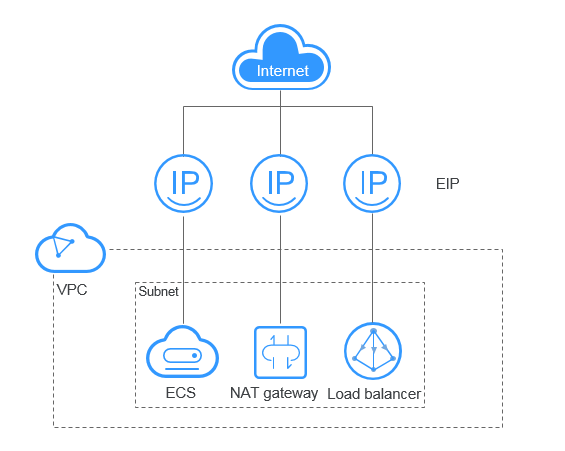
The Elastic IP (EIP) service enables your cloud resources to communicate with the Internet using static public IP addresses and scalable bandwidths. A resource with an EIP can access the Internet directly, but a resource with only a private IP address cannot.
EIP
EIPs can be bound to or unbound from ECSs, BMSs, virtual IP addresses, NAT gateways, or load balancers.
Each EIP can be bound to only one cloud resource.
- Each EIP can be bound to only one ECS. If an EIP has been bound to an ECS, it cannot be bound to other cloud resources. You need to unbind the EIP from the ECS before binding it to another cloud resource in the same region.
- The EIP and the ECS must be in the same region.
EIP Bandwidth
Bandwidth refers to the maximum amount of data that can be transmitted in a given amount of time (generally one second). A larger bandwidth value indicates a stronger transmission capability. Bandwidth is classified into public bandwidth and private bandwidth.
- The metrics about outbound bandwidth on the Cloud Eye console are Outbound Bandwidth and Outbound Traffic.
- The metrics about inbound bandwidth on the Cloud Eye console are Inbound Bandwidth and Inbound Traffic.
| Type | Description |
|---|---|
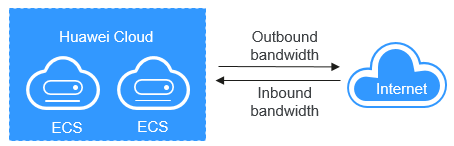
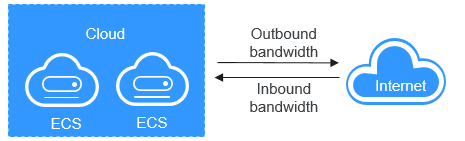
| Outbound bandwidth | Bandwidth consumed when data is transferred from Huawei Cloudthe cloud platform to the Internet. For example, the outbound bandwidth is consumed when ECSs provide services accessible from the Internet or when FTP clients download resources from the ECSs. The metrics about outbound bandwidth on the Cloud Eye console are Outbound Bandwidth and Outbound Traffic. |
| Inbound bandwidth | Bandwidth consumed when data is transferred from the Internet to Huawei Cloudthe cloud platform. For example, the inbound bandwidth is consumed when downloading resources from the Internet to ECSs and when FTP clients upload resources to the ECSs. The metrics about inbound bandwidth on the Cloud Eye console are Inbound Bandwidth and Inbound Traffic. |
EIP Types
EIPs can use dynamic BGP
- Dynamic BGP provides automatic failover and chooses the best path based on the real-time network conditions and preset policies.
- When a fault occurs on a carrier's link, dynamic BGP will quickly select another path to take over services, ensuring service availability.