

Handling a Local Disk Replacement Event
Scenarios
When the system detects that data cannot be read from or written to local disks of ECSs (including bare metal ECSs) due to hardware faults or data exceptions, it will generate a local disk replacement event.

Local disks do not provide data high availability (HA). Data on faulty local disks may be partially or completely damaged and cannot be restored. You are advised to back up local disk data as soon as receiving the event notification.
During the repair of local disks, you can redeploy ECSs to quickly recover services. However, this method will cause all local disk data to be lost and the ECSs to be restarted. You need to back up all local disk data before this operation.
If you have any questions about the impact or handling of the local disk replacement event, do not authorize disk replacement. Instead, contact technical support for assistance.
The solution for handling local disk replacement events in the Pending authorization state varies depending on the ECS type. You can select an appropriate solution based on your service requirements.
- Solution for disk-intensive (D series) ECSs
- Solution for bare metal ECSs (with the .physical suffix)
Prerequisites
- If you need to perform operations as an IAM user, ensure that the IAM user has been granted the required permissions.
Event query and handling require the permissions defined in the following policies:
- Query events: ecs:instanceScheduledEvents:list
- Accept and authorize events: ecs:instanceScheduledEvents:accept
- Change the reservation time: ecs:instanceScheduledEvents:update
For details about how to grant permissions to IAM users, see Using IAM Roles or Policies to Grant Access to ECS.
- If you choose to handle the local disk replacement event by authorizing disk replacement, perform the following operations first:
- Back up data stored on faulty local disks if you want to retain the local disk data.
- Preprocess local disks based on your instance type. For details, see Preprocessing for Local Disk Replacement.
- If you choose to handle the local disk replacement event by redeploying the ECS, add nofail to all data disks to preprocess local disks.
For details, see Preprocessing for Instance Redeployment.
Authorizing Disk Replacement
- Log in to the management console.
- Click
 in the upper left corner and select a region and project.
 - Click
 . Under Compute, choose Elastic Cloud Server.
 - Choose Events from the left navigation pane. Figure 1 Events

- On the Events page, in the search box of the event list, filter the local disk replacement events in Pending authorization state.
- Select Event Type and then Local disk replacement.
- Select Event Status and then Pending authorization.
- Click Authorize Disk Replacement in the Operation column. Figure 2 Authorizing disk replacement (for disk-intensive ECSs)

- Select the checkbox and click Next.
- Specify Authorization.
- Select Now.
The disk replacement will be completed within five working days generally after the system receives the request.
Figure 3 Selecting Now

- Select Later and specify Scheduled Time.
After the system receives the request, the disk replacement will be completed within five working days after the scheduled replacement time.
Figure 4 Selecting Later

You can change the reservation time as needed. For details, see Changing the Reservation Time.
- Select Now.
- Enter AGREE in the text box below to authorize the local disk replacement.
- Click OK.
After you submit the authorization request, the event status becomes To be executed. After the system receives the request, it decides when to change the event status to Executing based on the replacement time you specify.
When the status of the local disk replacement event becomes Execution succeeded, the local disk replacement is complete. Check the status of services running on the instance.
Redeployment
- Log in to the management console.
- Click in the upper left corner and select a region and project.
- Click
 . Under Compute, choose Elastic Cloud Server.
 - Choose Events from the left navigation pane. Figure 5 Events
- On the Events page, in the search box of the event list, filter the local disk replacement events in Pending authorization state.
- Select Event Type and then Local disk replacement.
- Select Event Status and then Pending authorization.
- Locate the target event and click Redeployment in the Operation column. Figure 6 Redeployment

- Select the checkbox and click Next.
- Enter AGREE to confirm the redeployment. Figure 7 Confirming the instance redeployment

- Click OK.
After you submit the redeployment request, the event status becomes To be executed. After the system receives the request, it changes the event status to Executing and starts to redeploy the instance.
When the status of the local disk replacement event becomes Execution succeeded, the instance redeployment is complete. Check the status of services running on the instance.
Changing the Reservation Time
After you submit a scheduled authorization request, the event status changes to To be executed. You can change the reservation time as needed.

You must change the reservation time at least 30 minutes before the current reservation time.
- Log in to the management console.
- Click in the upper left corner and select a region and project.
- Click
 . Under Compute, choose Elastic Cloud Server.
 - Choose Events from the left navigation pane.
- On the Events page, in the event list, filter the local disk replacement events in To be executed state.
- In the Event Type column, select Local disk replacement.
- In the Event Status column, select To be executed.
- In the Operation column of the event to be executed, click Change Reservation Time. Figure 8 Changing the reservation time
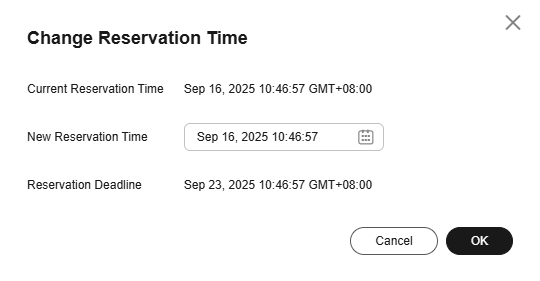
- Specify New Reservation Time and click OK.
After the change is complete, the new reservation time is displayed in the Execution Time column of the event list.
What is your overall rating for this page?
Thank you very much for your feedback. We will continue working to improve the documentation.See the reply and handling status in My Cloud VOC.
For any further questions, feel free to contact us through the chatbot.
Chatbot


