

How Is the Elastic Service Bandwidth Charged?
If the actual bandwidth used by a service exceeds the service bandwidth, rate limiting and packet loss may occur. Enabling elastic service bandwidth can effectively prevent rate limiting and packet loss.
The elastic bandwidth of AAD is a post-paid, value-added item. Total available bandwidth = Service bandwidth + Elastic bandwidth
Billing Rules
The elastic bandwidth of AAD supports monthly 95th percentile billing. It can be scaled to up to 10,000 Mbit/s.

If your actual bandwidth exceeds the service bandwidth plus the elastic bandwidth, rate limiting and packet loss may occur. Select an elastic bandwidth based on your traffic volume.
The elastic bandwidth fees in different scenarios are described as follows.
| Service Bandwidth | Elastic Bandwidth | Actual Service Bandwidth | Elastic Bandwidth Fee | Description |
|---|---|---|---|---|
| 100 Mbit/s | Disabled | 120 Mbit/s | No elastic bandwidth fees will be generated. | If bandwidth exceeds your configured quota, traffic may be limited and packet loss may occur. |
| 100 Mbit/s | Enabled | 100 Mbit/s | No elastic bandwidth fees will be generated. | If the actual service bandwidth is less than or equal to the service bandwidth, no elastic service bandwidth fee is generated. |
| 100 Mbit/s | Enabled | 120 Mbit/s | Elastic bandwidth fees will be generated. | If the actual bandwidth is higher than the service bandwidth, elastic service bandwidth fees will be generated. |
Billing Principles
- Monthly 95th percentile billing
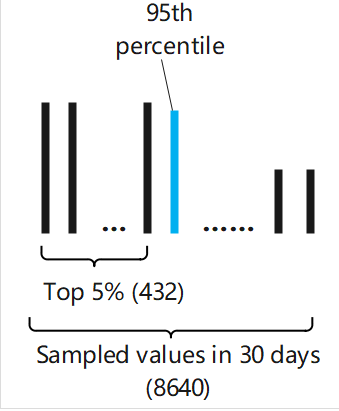
Traffic is averaged over 5-minute intervals throughout each calendar month. These 5-minute averages are sorted in descending order, the top 5% are discarded, and the highest remaining value is taken as the billing bandwidth. Figure 1 shows how to calculate the monthly 95th percentile bandwidth for 30 days.
What is your overall rating for this page?
Thank you very much for your feedback. We will continue working to improve the documentation.See the reply and handling status in My Cloud VOC.
For any further questions, feel free to contact us through the chatbot.
Chatbot


