

Overview
What is a PTR Record?
A PTR record provides the domain name associated with an IP address. It is the opposite of a regular DNS lookup. PTR records are used in many network applications. For example, email servers use reverse resolution to verify the sender's IP address to reduce spam and network fraud.
After a recipient server receives an email, it checks whether the IP address and domain name of the sender server are trustworthy and determines whether the email is spam. If the recipient server fails to obtain the domain name mapped to the sender's IP address, it concludes that the email is sent by a malicious host and rejects it. It is necessary to configure pointer records (PTR) to point the IP addresses of your email servers to domain names.
Reverse Resolution Process
In the following figure, an ECS serves as an email server, and a PTR record is configured to map the EIP of the ECS to the domain name configured for accessing the email server.
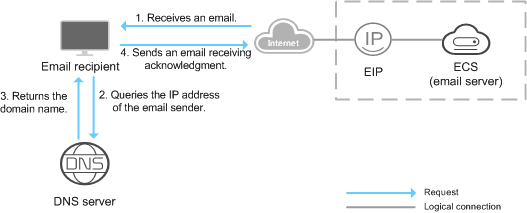
- Enterprise A sends an email, and enterprise B receives it: The email recipient (for example, the local email server) receives an email from the external network.
- Enterprise B triggers reverse DNS resolution: To verify that the email is not from a forged IP address, the email recipient proactively sends a reverse resolution request to the DNS server to query the domain name mapped to the email sender's IP address (that is, the EIP).
- The DNS server returns the resolution result: The DNS server returns the domain name (for example, mail.companyA.com) mapped to the email sender's IP address to the email recipient based on PTR records.
- If the verification is successful, the recipient receives the email: The email recipient checks whether the obtained domain name is the same as the actual domain name of the email. If the domain names are the same, the email recipient returns a message indicating that the email has been received to the EIP (associated with the ECS).

The preceding describes the reverse resolution process of the DNS service. Information about how the email recipient checks the credibility of the sender's IP address and whether the domain name is available on the Internet is not provided here.
If no PTR records are configured, the recipient server will treat emails from the email server as spam or malicious and discard them. Therefore, if you want to build an email server, it is necessary to add a PTR record to map the email server IP address to your domain name.
Related Operations
| Operation | Scenario | Constraints |
|---|---|---|
| Create PTR records for cloud resources such as ECS. |
| |
| Modify, delete, batch delete, or query PTR records. |
|


