

Overview of Real-Time Jobs
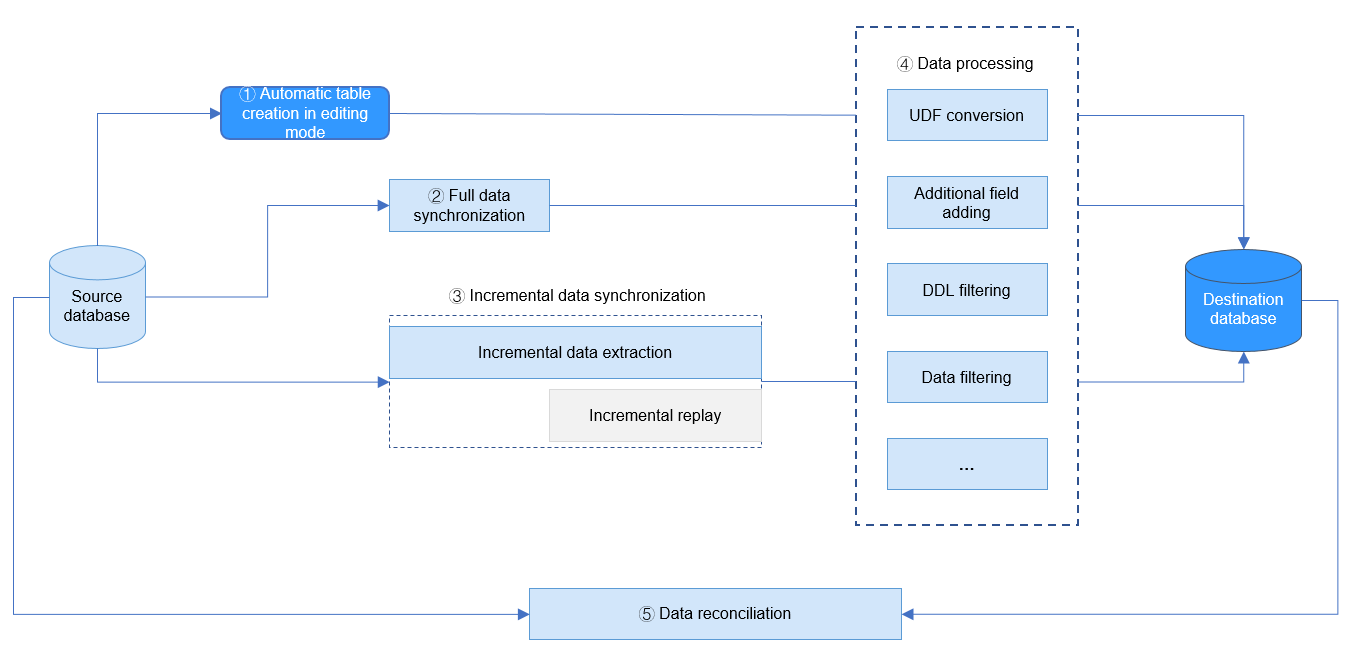
The DataArts Migration module of DataArts Studio provides real-time data synchronization, which replicates data from one source to another without affecting data consistency. This function enables real-time flow of key service data.
- Typical scenarios: real-time analysis, report systems, and data warehouse environments
- Characteristics: Real-time synchronization meets requirements such as many-to-one and one-to-many synchronization, dynamic addition and deletion of synchronization tables, and synchronization between tables with different names. Figure 1 How real-time synchronization works
Functions
Real-time migration jobs support real-time data synchronization between a wide range of data sources in various scenarios. You can synchronize multiple database tables in full or incremental mode at a time. The following figure shows the detailed functions.
| Function | Description |
|---|---|
| Data synchronization between sources | Various types of data sources are supported. You can combine multiple input and output data sources to form a synchronization link. For details, see Supported Data Sources. |
| Data synchronization in multiple scenarios | Real-time incremental data synchronization is supported for a table, an entire database, and database and table shards.
|
| Real-time synchronization task configuration | Real-time data synchronization can be implemented through simple visualized configuration.
|
| Real-time synchronization task O&M | Recovering tasks upon exceptions, dynamically adding or deleting tables, configuring alarms, and viewing and exporting task logs |
Synchronization Scenarios
DataArts Migration supports synchronization scenarios of multiple topology types. You can plan synchronization based on your requirements.
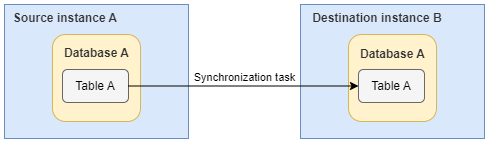
- Single table synchronization
A table in an instance can be synchronized to another instance.
The following links are supported:
to Hudi
Figure 2 Single table synchronization
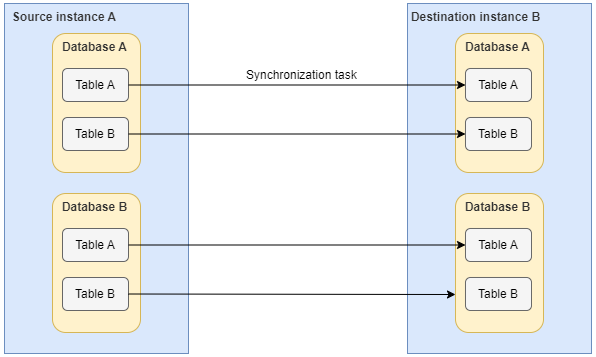
- Entire database synchronization
Multiple tables in multiple databases in an instance can be synchronized to another instance in real time. A task can synchronize a maximum of 200 tables.
The following links are supported:
- MySQL to MRS Hudi, MySQL to GaussDB(DWS), and MySQL to Kafka
- SQL Server to MRS Hudi and SQL Server to GaussDB(DWS)
- PostgreSQL to GaussDB(DWS), PostgreSQL to MRS Hudi, and PostgreSQL to
- Oracle to GaussDB(DWS), Oracle to MRS Hudi, and Oracle to
- GaussDB Centralized/Distributed to GaussDB(DWS), GaussDB Centralized/Distributed to MRS Hudi, and GaussDB Centralized/Distributed to
Figure 3 Entire database synchronization
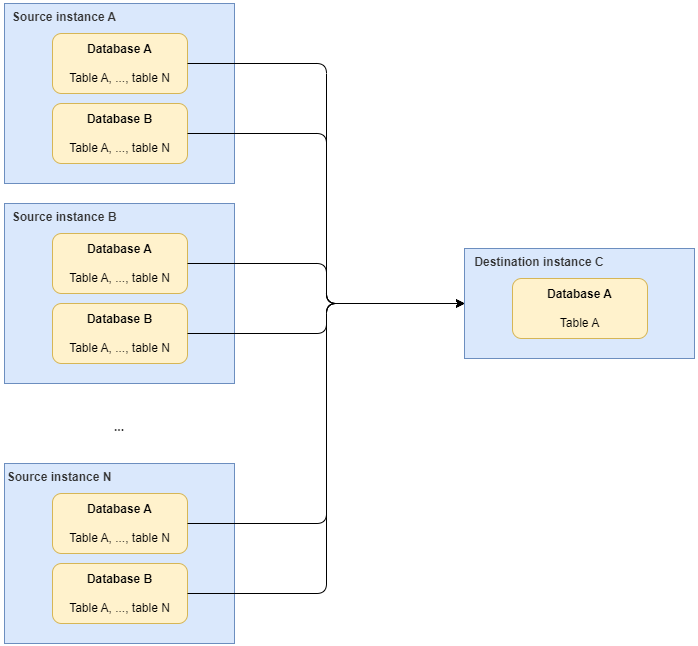
- Database and table shard synchronization
Multiple table shards of multiple databases in multiple instances can be synchronized to a database table in an instance.
The following links are supported:
- MySQL to MRS Hudi and MySQL to GaussDB(DWS)
- PostgreSQL to GaussDB(DWS)
Figure 4 Database and table shard synchronization
Basic Features
Real-time data migration provides support for big data development and has the following features:
- Timeliness: Data can be synchronized within seconds.
- Reliability: Mechanisms such as recovery upon exceptions and automatic retry ensure data consistency and accuracy.
- Diversity:
- Diverse data sources: Multiple data sources can be selected at the source and destination.
- Diverse scenarios: Some links support full and incremental synchronization, and some links support database and table shards.
- Maintainability: Job monitoring and logs are supported, enabling O&M engineers to locate faults.
- Ease-of-use: You only need to configure necessary information on the console.


