

How Many Domain Name Levels Does DNS Support?
When you create a public zone, a maximum of 16 levels of domain names (including top-level domains) are supported.
Take example as an example.
- DNS supports the following levels for domain names with the .com suffix:
- Primary domain name: example.com, which is considered as a level-2 domain name (including the top-level domain).
- Subdomain: A maximum of 14 prefixes can be added before the primary domain name, for example, 1.example.com, 1.2.example.com, 1.2.3.example.com,...,1.2.3.4.5.6.7.8.9.10.11.12.13.14.example.com.
- DNS supports the following levels for domain names with the .com.cn suffix:
- Primary domain name: example.com.cn, which is considered as a level-2 domain name (including the top-level domain).
- Subdomain: A maximum of 14 prefixes can be added before the primary domain name, for example, 1.example.com.cn, 1.2.example.com.cn, 1.2.3.example.com.cn,...,1.2.3.4.5.6.7.8.9.10.11.12.13.14.example.com.cn.
Domain Name Hierarchy
The domain name resolution involves a hierarchical structure and often uses recursive queries.
The following uses example.com as an example to describe the structure and levels of a domain name.
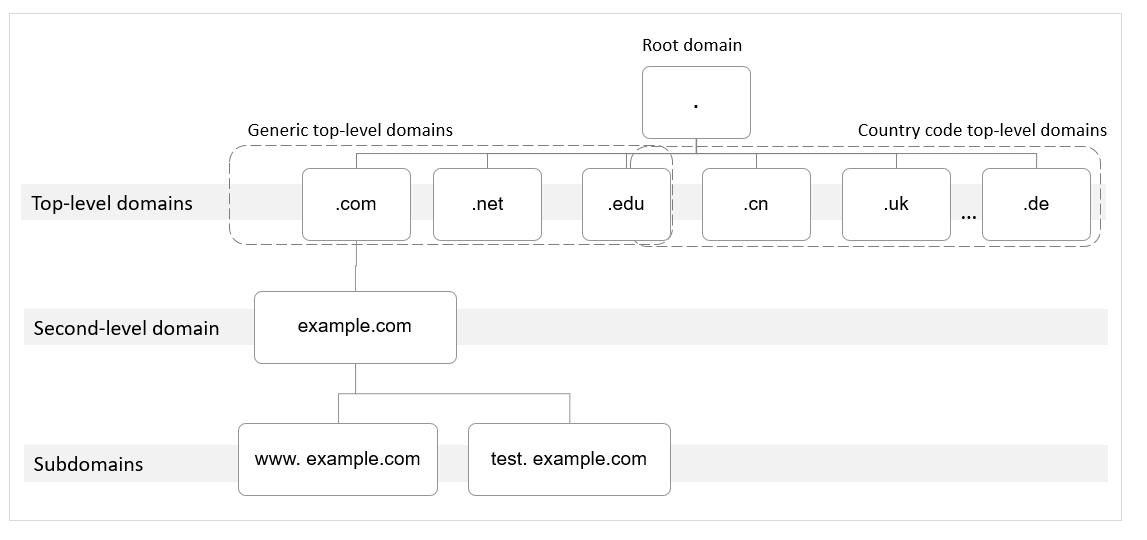
- Root domain
A period (.) is the designation for the root domain.
A fully qualified domain name (FQDN) ends with a period (example.com.). When you enter a domain name (example.com) in the browser, the DNS system will automatically add a period in the end.
Root domain names are resolved by root name servers that hold the addresses of top-level domain servers.
- Top-level domain
Below the root domain are top-level domains, which are categorized into two types:
- Generic top-level domain (gTLD), such as .com, .net, .org, and .top
- Country code top-level domain (ccTLD), such as .cn, .uk, and .de
Top-level domains are resolved by top-level domain servers that hold the addresses of second-level DNS servers. For example, the top-level domain server of .com saves the addresses of all DNS servers of second-level domains that end with .com.
- Second-level domain
Second-level domains (such as example.com) are subdomains of top-level domains and are resolved by second-level DNS servers, which provide authoritative domain name resolution services.
For example, if you purchase example.com from a domain name registrar and set a DNS server for the domain name, the DNS server will provide authoritative resolution for example.com, and its address will be recorded by all top-level domain servers.
If you host domain names on the Huawei Cloud DNS service, authoritative DNS servers will provide authoritative resolution services for your domain names.
- Subdomain
Second-level domains can be further divided into subdomains (such as www.example.com) to indicate specific servers or services.


