

Help Center/ GaussDB/ Developer Guide(Distributed_V2.0-3.x)/ SQL Optimization/ Reviewing and Modifying a Table Definition/ Overview
Updated on 2025-08-19 GMT+08:00
Overview
In a distributed framework, data is distributed on DNs. Data on one or more DNs is stored on a physical storage device. To properly define a table, you must:
- Evenly distribute data on each DN to avoid the available capacity decrease of a cluster caused by insufficient storage space of the storage device associated with a DN. Select a proper distribution key to avoid data skew.
- Evenly assign table scanning tasks on each DN to avoid that a single DN is overloaded by the table scanning tasks. Specifically, do not select columns in the equivalent filter of a base table as the distribution key.
- Reduce the data volume scanned by using the partition pruning mechanism.
- Minimize random I/Os by using clustering.
- Avoid data shuffle to reduce the network pressure by selecting the join-condition or group by column as the distribution key.
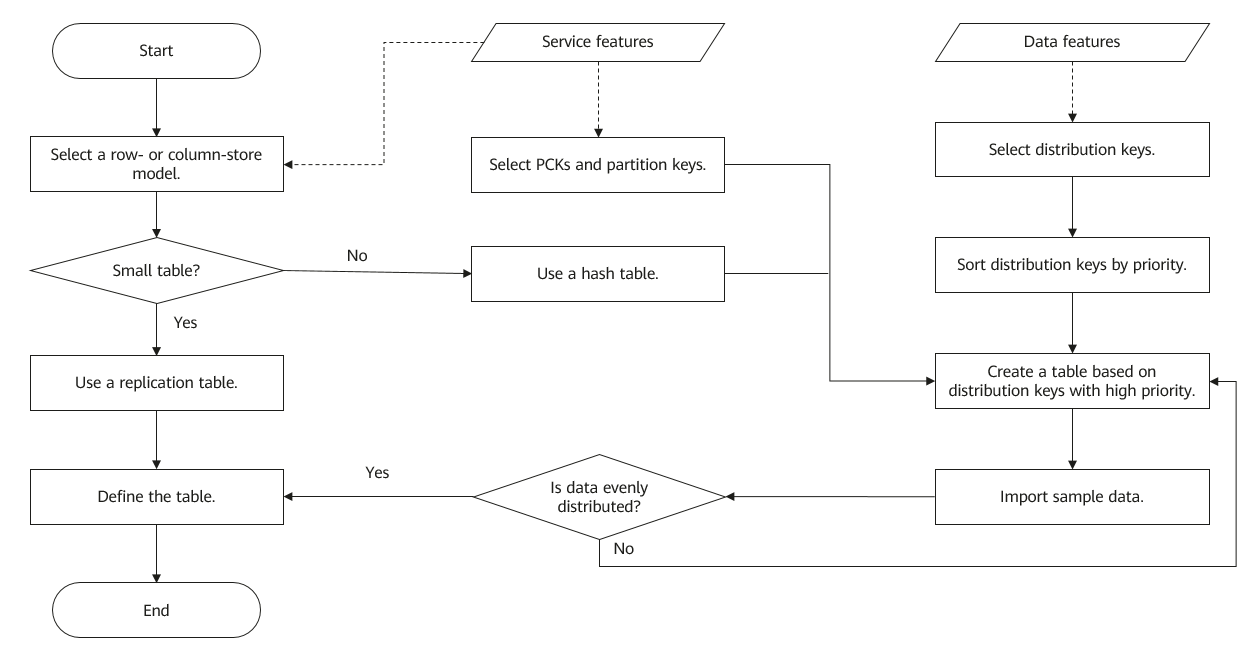
The distribution key is the core for defining a table. Figure 1 shows the procedure of defining a table. The table definition is created during the database design and is reviewed and modified during the SQL statement optimization.
Parent topic: Reviewing and Modifying a Table Definition
What is your overall rating for this page?
0
1
2
3
4
5
6
7
8
9
10
Very dissatisfiedVery satisfied
Thank you very much for your feedback. We will continue working to improve the documentation.
The system is busy. Please try again later.


